That Mall Where You Bought Your Back-to-School Jeans? It Might Be Powering the Future.
Across America, the hollowed-out husks of dead shopping malls are being reborn as data centers. The opportunity is enormous, and so are the obstacles.
Geno J. Cortina
5/20/20265 min read
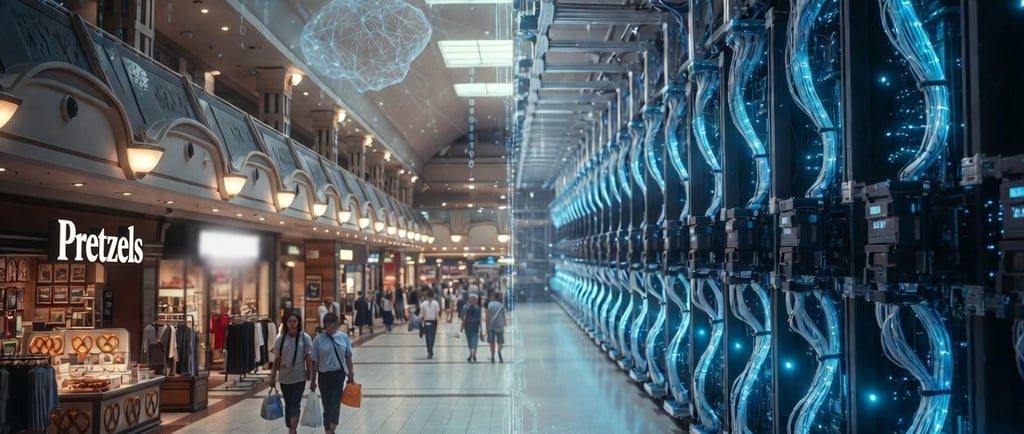
You remember the smell: Auntie Anne's pretzels, a cloud of Abercrombie cologne, the faint rubber-and-carpet funk of a Foot Locker. You remember the wide concourses on a late-August Saturday, crowded with families loading up on new sneakers and spiral notebooks before the school year kicked off. And then, gradually, you remember the mall going quiet. An anchor store closing, a food court with more empty stalls than open ones, a parking lot that never quite filled up again.
Thousands of American malls have gone through exactly that slow fade. But they haven't disappeared. They've been reborn, and their second act is stranger and more consequential than anything a 1990s mall rat could have imagined. They're becoming data centers. Quietly, steadily, and with increasing urgency, the concrete fortresses of American retail are being rewired to house the servers, cooling systems, and fiber-optic infrastructure that the AI era demands. It's a transformation full of promise, and one that's proven harder to pull off than it looks.
A PERFECT STRUCTURAL MATCH
The logic is almost too neat. A regional mall typically spans 500,000 to 1.2 million square feet, with huge single-story floorplates and robust electrical infrastructure already in place. 1.) Their suburban locations, once considered a liability as foot traffic declined, turn out to be ideal for data centers: close enough to cities to deliver low-latency connectivity, far enough to find affordable land and power grid capacity. 2.) And because distressed mall properties can be acquired at a steep discount, developers can build out data center capacity far faster and cheaper than breaking ground on a brand-new facility. 3.)
BY THE NUMBERS
The U.S. has roughly 1,000 enclosed malls, and hundreds are classified as distressed or dead
Data centers typically pay more in monthly rent than retail tenants, and never miss a payment
A converted mall can reach market faster than new construction, skipping lengthy permitting
Malls' existing power feeds and loading docks make them naturals for server infrastructure
IT'S ALREADY HAPPENING
This isn't a theory. It's a documented trend with years of real examples. As far back as 2008, Lifeline Data Centers converted the Eastgate Mall in Indianapolis into a functioning data facility 4.) Between 2012 and 2013, AiNET converted a former Boscov's department store at Marley Station Mall in Maryland into its CyberNAP data center. QTS Realty Trust acquired the Lone Star Mall site in Dallas and transformed it into a high-capacity data campus. 5.)
More are in the pipeline. The site of the demolished Landover Mall in Maryland is being considered for a campus called Brightseat Tech Park 6.), with a potential groundbreaking in 2026. Even Simon Property Group, the largest mall operator in the country, has acknowledged publicly that it's exploring data center conversions for underperforming properties. 7.)
The AI boom doesn't just need data centers. It needs them fast, and it needs them everywhere.
NOT WITHOUT ITS CHALLENGES
The opportunity is real, but the conversion path is rarely straightforward. Mall buildings were designed to move people and merchandise, not to run at the electrical intensity that modern computing demands. Even properties with solid baseline infrastructure typically require significant upgrades to power distribution, cooling systems, and humidity controls before they can support high-density server loads. 8.)
Power availability has become the single most critical factor in data center development, and getting it isn't simple. 9.) Navigating a complex interconnection process involving utilities, regional transmission organizations, and regulatory bodies, all of which are already backlogged in many markets.10.) In regions where grid capacity is tight, developers are increasingly being asked to bring their own on-site power generation rather than drawing from the local supply, adding cost and complexity to what might have looked like a bargain acquisition. 11.)
Zoning is another friction point. Data centers don't fit neatly into traditional commercial or industrial land-use categories, and many municipalities are still scrambling to write rules for them. A mall zoned for retail can face a lengthy reclassification process before a data center can legally operate on the site, and some jurisdictions have begun restricting where data centers can locate altogether. 12.)
Community perception adds a final layer of complexity. Residents who watched a mall decline often hope for something that restores foot traffic and local jobs, not a facility that employs a handful of technicians and hums quietly behind a secured perimeter. Building public support requires developers to make the economic case clearly: property tax revenue, construction jobs, and the indirect benefits of attracting tech-sector employers to the region. It's a harder sell than a new food hall, but an increasingly necessary one.
WHY NOW
The timing isn't coincidental. The explosion in AI computing has created a near-insatiable appetite for data center capacity. Training large AI models and running inference at scale requires enormous amounts of power and physical space, and the industry is in a race to build it out. Greenfield data center development is slow, expensive, and increasingly constrained by power grid access. Dead malls short-circuit all of that
For the communities left behind by retail decline, the shift carries its own kind of poetic justice. An empty mall is an economic wound: lost jobs, lost tax revenue, a neighborhood anchor that simply stopped anchoring. A data center is a reliable tenant, a consistent tax base, and increasingly a jobs hub for electricians, engineers, and technicians whose skills are in extraordinary demand.
The pretzel shop is gone. The Foot Locker is gone. But the building, that sprawling, stubborn, overbuilt monument to American consumer culture, turns out to have had another life in it all along.
---
SOURCES
Woodcliff LLC. "Dying Malls Can Be Converted to Data Centers." December 28, 2025. https://www.woodcliffllc.com/blog/2025/12/28/dying-malls-can-be-converted-to-data-centers
DataCenters.com. "From Retail to Racks: How Malls and Big-Box Stores Are Becoming Data Center Real Estate." November 20, 2025. https://www.datacenters.com/news/from-retail-to-racks-how-malls-and-big-box-stores-are-becoming-data-center-real-estate-088f0ddd-76f1-4bb0-b0cb-dc337161b386
DataCenterRealEstate.com. "Retail to Data Center Conversions." November 20, 2025. https://www.datacenterrealestate.com/news/how-malls-and-big-box-stores-are-becoming-data-center-real-estate
Lifeline Data Centers. "Recycling on a Large Scale: Repurposing Shopping Malls into Data Centers." August 2021. https://lifelinedatacenters.com/data-center/recycling-on-a-large-scale-repurposing-shopping-malls-data-centers/
BizBlog. "Dead Malls Are Being Reborn as Data Centers and Warehouses." September 25, 2025. https://www.bizblog.com/how-dead-malls-are-being-reborn-as-data-centers-and-warehouses/
CoStar. "Why Simon Property Isn't Turning Malls Into Data Centers — Yet." May 2026. https://www.costar.com/article/283923276/why-simon-property-isnt-turning-malls-into-data-centers-yet
NY Engineers. "Repurposing Spaces: Warehouses and Data Centers Unite." September 25, 2024. https://www.ny-engineers.com/blog/repurposing-buildings-how-warehouses-and-data-centers-w
ork-together
DataCenterLtd. "The New Data Center Economy: Power Constraints, Grid Bottlenecks & the Future of Infrastructure Development." April 2026. https://www.datacenterltd.com/articles-and-resources/the-data-center-bottleneck-no-one-wants-to-price-in
Engineering News-Record. "Grid Access, Not Land, Emerges as Bottleneck for Data Center Construction." December 18, 2025. https://www.enr.com/articles/62227-grid-access-not-land-emerges-as-bottleneck-for-data-center-construction
LightBox. "Zoning and Land Use Considerations for Data Centers." April 10, 2025. https://www.lightboxre.com/insight/zoning-and-land-use-considerations-for-data-centers/
Smart Growth America. "Data Centers Are Here, and More Are Coming. Our Zoning Is Not Ready." April 2026. https://www.smartgrowthamerica.org/knowledge-hub/news/data-centers-are-here-and-more-are-coming-our-zoning-is-not-ready/
Stay informed
Receive tailored insights and updates from our team
Get in touch
Contact Us
+1-201-364-9955
Follow Us:
© 2026. Crocevia Advisors LLC All rights reserved.